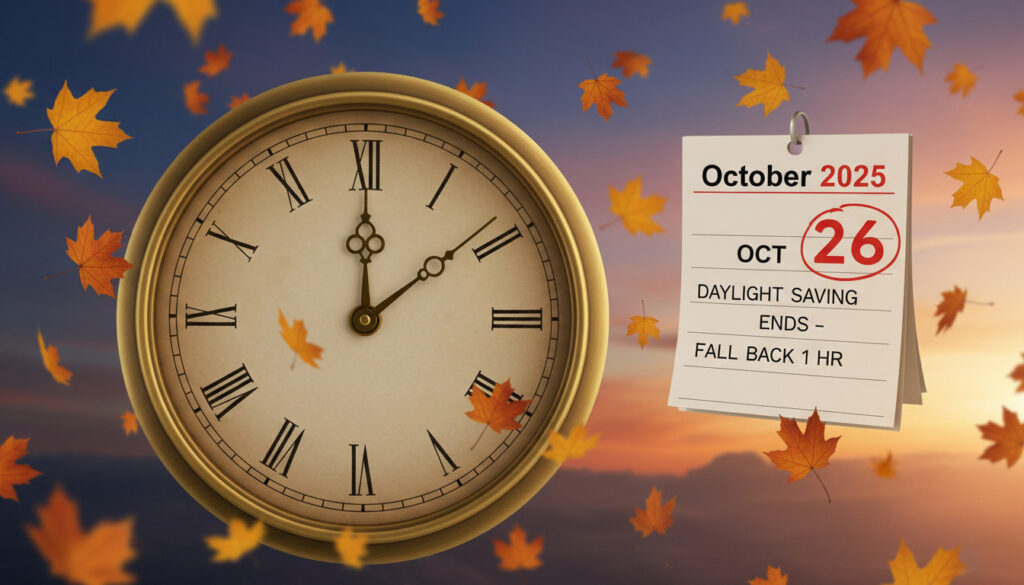
When Does Daylight Savings Time End 2025 – Date Time and Exceptions
Daylight Saving Time ends on Sunday, November 2, 2025, at 2:00 a.m. local time, when clocks across most of the United States turn back one hour to 1:00 a.m. The annual shift returns 60 minutes of morning light during winter months while reducing evening daylight, affecting everything from sleep schedules to energy consumption patterns nationwide.
The “fall back” transition marks the conclusion of the eight-month DST period that began in March. While digital devices connected to cellular and Wi-Fi networks adjust automatically, analog clocks, automotive dashboards, and many household appliances require manual correction. The change applies uniformly across time zones, occurring at 2:00 a.m. local time whether in Maine or California, according to ABC News.
Nearly all US states participate in this biannual ritual established by federal law, though notable exceptions create pockets of temporal consistency throughout the year. Arizona, Hawaii, and several US territories maintain standard time year-round, creating complex timezone boundaries that travelers and scheduling systems must navigate each November.
When Does Daylight Saving Time End in 2025?
| End Date | November 2, 2025 (First Sunday) |
| Change Time | 2:00 a.m. local → 1:00 a.m. |
| Action | Fall back 1 hour |
| Applies To | Most US states and territories |
- The transition occurs at 2:00 a.m. local time on the first Sunday in November, as mandated by the Uniform Time Act
- Clocks shift backward one hour, effectively repeating the 1:00 a.m. to 2:00 a.m. hour and providing extra sleep time
- The schedule remains unchanged from previous years, with DST lasting approximately 238 days from March to November
- Arizona (outside Navajo Nation), Hawaii, and five US territories remain on standard time year-round
- Permanent DST legislation remains pending in Congress without scheduled votes for 2025
- Standard time continues until DST resumes on March 8, 2026
- The time shift affects approximately 330 million Americans across six time zones, as reported by CBS News
| Year | DST Start | DST End | Duration |
|---|---|---|---|
| 2024 | March 10 | November 3 | 238 days |
| 2025 | March 9 | November 2 | 238 days |
| 2026 | March 8 | November 1 | 238 days |
What Time Do Clocks Change on DST End 2025?
2:00 a.m. Local Time Fall Back
The transition occurs precisely at 2:00 a.m. local time on November 2, 2025, instantly becoming 1:00 a.m. This standardized moment prevents confusion across time zones, ensuring the shift happens during early morning hours when commercial activity remains minimal.
Smartphones, computers, and network-connected devices update automatically through timezone databases maintained by operating system providers. However, mechanical clocks, wall appliances, automotive displays, and some IoT devices require manual intervention. The official US time portal provides synchronized reference points for verification.
Devices synchronized to cellular networks or internet time servers update automatically at 2:00 a.m. local time. The Navajo Nation, which extends into Arizona, New Mexico, and Utah, observes DST despite Arizona’s statewide exemption, creating unique timezone boundaries within the state that require special attention for travelers.
Full DST Schedule for 2025
Start Date: Second Sunday in March
The 2025 DST period begins on March 9 at 2:00 a.m., when clocks spring forward to 3:00 a.m., effectively removing one hour of sleep but extending evening daylight through summer months. This eight-month observance window remains consistent with the Energy Policy Act of 2005, which expanded DST by four weeks from its previous schedule.
The March-to-November framework applies uniformly to all participating states and territories, with no provisions for regional variation in start or end dates. Federal law prohibits states from altering these dates independently, though opting out entirely remains permissible through state legislation. Where Is Santa Right Now – NORAD Tracker Status 2025 operates across these same timezone boundaries during holiday operations.
Which US States Skip DST in 2025?
Hawaii, Most of Arizona, US Territories
Two US states and five territories maintain standard time throughout the year. Hawaii opted out shortly after the 1966 Uniform Time Act took effect, citing minimal daylight variation between seasons due to its tropical latitude. Arizona followed in 1968, with state legislators arguing that extending daylight into summer evenings would increase air conditioning demand and energy consumption during peak heat hours.
The US territories of American Samoa, Guam, Northern Mariana Islands, Puerto Rico, and the US Virgin Islands also remain on standard time year-round. Wikipedia’s comprehensive DST reference documents these exemptions alongside the complex timezone boundaries of the Navajo Nation, which does observe DST despite being located primarily within Arizona.
State legislators exempted Arizona in 1968 specifically to reduce evening energy consumption during summer months. By maintaining standard time, Arizona avoids the additional hour of evening sunlight that would otherwise extend peak air conditioning usage during 100-degree-plus temperatures.
While states may exempt themselves from DST observance through state law, federal statute prohibits any state from unilaterally adopting permanent Daylight Saving Time. Such changes require Congressional amendment to the Uniform Time Act of 1966.
Timeline of Daylight Saving Time Policy
- 1918: The United States first adopts DST as a wartime measure during World War I, implementing it nationwide for energy conservation.
- 1966: Congress passes the Uniform Time Act, standardizing DST dates nationwide while permitting states to opt out entirely.
- 1967: Arizona briefly observes DST before exempting itself permanently the following year.
- 2005: The Energy Policy Act extends DST by one month, moving the end date from October to early November.
- March 9, 2025: DST begins for the 2025 observance period.
- November 2, 2025: DST ends, returning the United States to standard time until March 2026.
Will Daylight Saving Time Become Permanent?
| Established Fact | Uncertain Outcome |
|---|---|
| DST ends November 2, 2025, as scheduled | Passage of the Sunshine Protection Act |
| Federal law requires uniform start/end dates | Congressional action on permanent DST authorization |
| Standard time resumes until March 8, 2026 | Implementation timeline for any permanent change |
| Nineteen states have passed laws supporting permanent DST | Whether legislation will reach the President’s desk in 2025 |
The Sunshine Protection Act, reintroduced in January 2025 in both chambers of Congress, proposes making DST permanent year-round. The bill passed the Senate unanimously in 2022 but stalled in the House of Representatives. Congressional records show the measure remains pending without scheduled floor votes.
Why Does the US Still Change Clocks?
The practice originated during World War I to conserve fuel by extending evening daylight hours, reducing the need for artificial lighting. Congress standardized the practice in 1966 to end the patchwork of local timezone observances that had created transportation and broadcasting chaos. Per a més informació sobre l’hora d’estiu, podeu consultar Què significa AM i PM.
The Energy Policy Act of 2005 extended DST by four weeks based on Department of Energy projections of conservation benefits, though subsequent studies have questioned the actual magnitude of electricity savings. Medical organizations now argue that the health costs of circadian disruption outweigh potential energy benefits. Department of Energy analyses continue to evaluate the policy’s efficacy. Canada Dollar Rate Today in Punjab – Live CAD to INR Rates reflects similar timezone coordination challenges in international finance.
What Do Medical Experts Say?
Major medical associations have taken formal positions against the biannual clock changes. The American Medical Association and American Academy of Sleep Medicine advocate for permanent standard time, arguing that morning sunlight alignment better supports human circadian biology.
“The transition back to standard time disrupts circadian rhythms, potentially causing mental health issues, appetite changes, and mood problems with adjustment periods lasting from seven days to several weeks.”
— American Medical Association consensus statement, via medical analysis
Preparing for November 2, 2025
Americans should prepare for the November 2 transition by verifying automatic updates on critical devices and adjusting analog timepieces before bedtime on November 1. While the 2025 change will proceed as scheduled, legislative efforts to eliminate future clock changes continue advancing through state capitols and Congressional committees without definitive resolution.
Frequently Asked Questions
What is the history of Daylight Saving Time?
The US first implemented DST in 1918 during World War I for energy conservation. Congress standardized the practice nationwide in 1966 with the Uniform Time Act, though Arizona and Hawaii opted out. The Energy Policy Act of 2005 extended DST by one month to its current March-November schedule.
How does the DST change affect sleep?
The fall transition can disrupt circadian rhythms, causing mental health impacts, appetite changes, and mood disturbances. The American Academy of Sleep Medicine notes adjustment periods range from seven days to several weeks as bodies adapt to the new light-dark cycle.
When does DST end in other countries in 2025?
Most European countries end DST in late October, approximately one week earlier than the United States. The majority of nations worldwide, including most of Asia and Africa, do not observe daylight saving time at all.
Can states opt out of Daylight Saving Time?
Yes. States may exempt themselves from DST observance through state legislation, as Hawaii and Arizona have done. However, federal law prohibits states from adopting permanent DST without Congressional approval amending the 1966 Uniform Time Act.
Why did the US extend DST in 2005?
The Energy Policy Act of 2005 extended DST by four weeks to early November based on projected energy conservation goals. Lawmakers anticipated reduced evening electricity usage during the extension period, though subsequent studies have debated the actual savings achieved.
More related posts
 Rajasthan Royals vs Chennai Super Kings Match Scorecard – Full IPL 2024 Result
 CPP Max Contribution 2024: Complete Guide to Rate and Limit
 How to Get Rid of a Sinus Infection in 24 Hours
 House for Sale St Hyacinthe: Centris, RE/MAX Listings
 Zodiac Signs by Month – Complete Date Chart and Guide
 Katherine Heigl: Career, Kids, Surgery & What She Does Now
 Metropolis at Metrotown Directory: Guide to Shops, Map & Food
 Globe and Mail Obituaries: Search Costs and Submission Guide