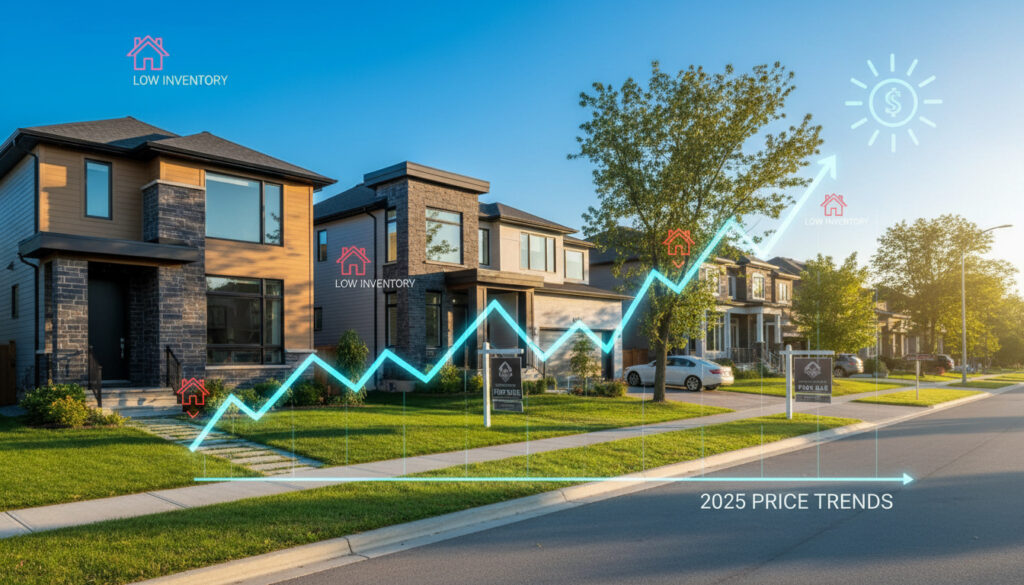
Oakville Homes for Sale – 2025 Prices Trends Inventory
The Oakville real estate market entered 2025 on a markedly different trajectory than previous years, with average home prices retreating from historic highs and inventory reaching levels unseen in over a decade. Prospective buyers now navigate a landscape where the average selling price hovers near $1.55 million, representing a significant cooling from the frenzied appreciation of 2021-2022. This shift has transformed the municipality into a buyer-favorable environment, characterized by elevated housing stock and weakened seller leverage.
Data from the Canadian Real Estate Association (CREA) and local brokerages reveal a market in transition. By December 2025, the MLS Home Price Index composite benchmark had fallen to $1,052,600, down 10.1% year-over-year, while single-family homes experienced even steeper corrections at 18.1% below December 2024 figures. Active residential listings climbed to 1,272 units, the highest December volume in 15 years, fundamentally altering negotiation dynamics between buyers and sellers.
For those monitoring Oakville Homes for Sale – Latest MLS Listings and Market Guide, the current environment presents distinct opportunities. First-time buyers targeting the $600,000–$1 million range find stronger availability, while luxury segments continue attracting high-net-worth individuals seeking proximity to Toronto. Understanding these bifurcated conditions requires examining specific price points, inventory categories, and neighborhood dynamics across this lakeside community.
What Is the Average Home Price in Oakville?
Pricing data from late 2025 reveals significant disparities across property categories, with detached homes maintaining premium valuations despite broader market corrections. The average selling price across all segments settled at approximately $1.55 million by September 2025, though composite benchmarks suggest lower median figures when weighted for property type.
- Detached Homes: $2.2 million (down 2%)
- Townhouses: $1.0 million (down 3%)
- Condo Apartments: $694,000 (down 6%)
- Condo Townhomes: $690,000 median (down from $790,000)
Key Market Indicators
- The MLS Home Price Index benchmark hit $1,052,600 in December 2025, marking a 10.1% annual decline
- Single-family homes averaged $1.68 million, representing an 18.1% year-over-year drop according to December market reports
- Monthly price depreciation reached 2.7% at peak cooling periods during 2025
- Freehold townhomes demonstrated relative resilience, with median prices rising from $1,175,000 to $1,225,000 between January 2024 and January 2025
- Only 5.7% of homes sold above list price by January 2025, collapsing from 27.3% in 2024
- Median days on market stabilized at 24 days, indicating sustained transaction velocity despite price softness
| Property Category | Average Price (Dec 2025) | Year-over-Year Change | Data Source |
|---|---|---|---|
| MLS Composite Benchmark | $1,052,600 | -10.1% | CREA Statistics |
| Single-Family Detached | $1,680,000 | -18.1% | OMDREB |
| Freehold Townhomes | $1,225,000 (median) | +4.3% | Regional Analysis |
| Condominium Apartments | $694,000 | -6% | Market Analytics |
| Condominium Townhomes | $690,000 (median) | -12.7% | Price Trend Reports |
| Overall Average (Sept) | $1,550,000 | -7% | Fisher Group Data |
Where Are the Best Neighborhoods in Oakville to Buy a Home?
Neighborhood selection in Oakville increasingly correlates with transit infrastructure and price segmentation rather than traditional geographic prestige alone. Enhanced GO Train services have elevated specific corridors, while the upper-middle market continues gravitating toward established enclaves with lake access or top-tier school catchments.
Transit-Connected Districts
Infrastructure investments surrounding improved GO Train connectivity have stimulated activity in certain neighborhoods, particularly those offering expedited commutes to Toronto’s core. These areas appeal to professionals who retained employment in the city center despite the broader adoption of hybrid work arrangements.
First-Time Buyer Territories
Properties priced between $600,000 and $1 million—predominantly condominium apartments and entry-level townhomes—constitute the strongest performing demand segment. These units sell faster than luxury inventory and concentrate in newer developments and periphery neighborhoods where per-square-foot costs remain manageable for dual-income households.
Luxury Market Concentrations
The luxury sector operates independently from broader cooling trends, attracting international investors and high-net-worth buyers. These properties, often exceeding $2.5 million, cluster in established heritage districts and waterfront communities where exclusivity and proximity to Toronto create premium valuations resistant to interest rate fluctuations.
How Many Homes Are Currently for Sale in Oakville and What Types Are Available?
Inventory accumulation defines the current market characterization, with active listings reaching generational highs while sales volume contracts. This imbalance has fundamentally shifted leverage toward purchasers, who now evaluate properties with reduced urgency and heightened scrutiny.
Current Inventory Levels
December 2025 concluded with 1,272 active residential listings, representing a 9.9% increase from December 2024 and the highest December inventory in more than 15 years. This saturation extends across all property categories, though townhome and condominium availability has expanded most dramatically relative to historical norms.
New Listing Volatility
Monthly listing activity fluctuated significantly throughout 2025. September saw 928 new listings—a 27% month-over-month surge—as sellers who withheld properties during previous rate hikes finally entered the market. By December, new listings moderated to 334 units, down 12.3% annually, suggesting potential inventory stabilization heading into 2026.
Property Type Availability
Detached homes comprise the largest single category by dollar volume, though condominium apartments and townhomes dominate transaction counts. Smaller-footprint properties under 1,200 square feet show disproportionately high availability, reflecting investor divestment and downsizing activity among aging demographics.
With inventory at 15-year highs and only 5.7% of properties selling above asking price, buyers currently possess unprecedented negotiation power to request closing date flexibility, inclusion of fixtures, and minor repairs—concessions largely unavailable during the 2021-2022 seller’s market.
Is Now a Good Time to Buy a Home in Oakville?
Market timing analysis suggests 2025 favored purchasers, though forward-looking indicators present mixed signals. The Bank of Canada’s neutral stance on future rate adjustments suggests the window for maximum affordability may have reached its nadir by December 2025.
Buyer-Seller Dynamics
A persistent bid-ask gap characterizes current transactions, with buyers submitting offers substantially below asking prices to test seller motivation. This dynamic replaced the competitive bidding wars of previous years, though median days on market remain relatively brief at 24 days.
Economic Considerations
Immigration-driven population growth continues supporting underlying demand, particularly among families attracted to Oakville’s school districts and amenities. However, affordability constraints persist despite rate stabilization, forcing many households to evaluate purchasing power carefully against monthly carrying costs.
While analysts initially projected 3-6% price appreciation for 2025, actual declines materialized instead. The Bank of Canada’s December messaging indicated rates may have reached their near-term floor, diminishing expectations for further mortgage relief that could stimulate price recovery.
Sellers who overprice properties face extended market times, while buyers targeting realistic asking prices encounter limited competition. International buyers monitoring Canada Dollar Rate Today in Punjab – Live CAD to INR Rates should note that currency advantages compound the pricing softness for foreign capital deployment.
How Has the Oakville Real Estate Market Evolved Recently?
- : Freehold townhomes median at $1,175,000; condo townhomes median at $790,000; 27.3% of sales above list price
- : Market begins visible cooling phase as rate hikes delay transaction activity
- : Only 5.7% of homes sell above asking; condo apartments median rises marginally to $580,000
- : Average price drops to $1.55 million (down 7% YoY); 928 new listings flood market; buyer viewings increase 10% annually to 12,048
- : MLS benchmark hits $1,052,600 (down 10.1% YoY); inventory reaches 1,272 units; single-family homes down 18.1%
What Do We Know for Certain About Oakville Real Estate?
| Established Facts | Remaining Uncertainties |
|---|---|
| Prices declined 7-10% year-over-year across all segments by late 2025 | Whether inventory will continue accumulating or stabilize in Q1 2026 |
| Inventory levels reached 15-year highs for December | Potential impact of federal immigration policy changes on demand |
| Only 5.7% of January 2025 sales occurred above list price | Velocity of price recovery if rate cuts resume |
| Freehold townhomes appreciated 4.3% while other categories declined | Long-term effects of remote work normalization on commuter corridors |
| Bank of Canada suggests rates near neutral floor | New construction completion rates and their impact on supply |
What Economic Forces Are Shaping Oakville’s Housing Market?
Multiple macroeconomic factors converged to produce 2025’s cooling conditions. Interest rate volatility, while stabilizing, maintained monthly payment burdens that excluded entry-level buyers from detached home categories. Concurrently, sustained immigration flows into the Greater Toronto Area preserved underlying demand for mid-market properties, preventing the inventory accumulation from triggering a full market collapse.
Infrastructure development, specifically GO Train service enhancements, created micro-climates of stability within specific neighborhoods. These transit investments improved supply accessibility, potentially moderating price growth in connected districts relative to car-dependent areas. Additionally, affordability pressures forced demographic shifts, with empty-nesters accelerating downsizing timelines and young families extending rental periods before purchasing.
Where Does This Market Data Come From?
Statistics cited derive from authoritative industry sources including the Canadian Real Estate Association (CREA) MLS statistics, the Oakville Milton District Real Estate Board (OMDREB) monthly reports, and analytics compiled by the Fisher Group. These datasets track transaction volumes, pricing benchmarks, and inventory metrics across the Oakville market boundaries.
“Home viewings increased 8% month-over-month and 10% year-over-year to 12,048 in September, while offers submitted reached 569, up 21% month-over-month.”
— September 2025 Market Analysis, Fisher Group
Property-specific pricing for condominiums, townhomes, and luxury segments incorporates data from Roshan Realty and Mr. Sold Group analyses, which track median values across freehold and condominium tenure types separately. Segment-specific performance data reveals the divergence between asset classes, with freehold townhomes demonstrating counter-cyclical resilience while condominium townhomes experienced 12.7% median price erosion.
Key Takeaways for Oakville Home Buyers
The Oakville market of late 2025 offers genuine opportunities for prepared buyers, particularly those targeting the $600,000–$1,000,000 range where inventory accumulates fastest and seller motivation peaks. With benchmark prices down 10% and interest rates potentially stabilizing, the cost-of-entry differential from peak pricing has improved substantially. Prospective purchasers should consult updated Oakville Homes for Sale – Latest MLS Listings and Market Guide to identify specific opportunities in this buyer-favorable environment, while remaining cognizant that further significant rate relief appears unlikely based on current central bank guidance.
Frequently Asked Questions
What is the average price per square foot in Oakville?
While specific per-square-foot averages vary by neighborhood and property age, current market data suggests ranges between $550-$800 for condominiums and $400-$600 for detached homes, though these figures fluctuate significantly based on finish quality and location premiums.
Are luxury homes still selling in Oakville?
Yes, the luxury segment remains active, attracting high-net-worth individuals and international investors. Unlike the broader market, luxury properties maintain stronger pricing power due to limited supply and exclusivity factors.
How long does the average home stay on the market?
Median days on market currently stand at 24 days, though this represents an increase from 2024 conditions. Overpriced properties may linger significantly longer, while competitively priced entry-level homes often sell within two weeks.
What price range offers the best value for first-time buyers?
Properties between $600,000 and $1,000,000 demonstrate the strongest liquidity and fastest sales velocity, indicating robust demand and resale security for first-time purchasers.
How do interest rates specifically impact Oakville buyers?
Elevated rates have reduced purchasing power by approximately 20-25% compared to 2021, forcing buyers into lower price brackets or smaller property types while increasing monthly carrying costs despite lower purchase prices.
Where can I find new listing alerts for Oakville?
New listing notifications are available through the Oakville Homes for Sale – Latest MLS Listings and Market Guide, which aggregates MLS data and provides real-time updates as properties enter the market.
Is condo or freehold townhome a better investment currently?
Freehold townhomes have shown price resilience with median values increasing 4.3%, while condo townhomes declined 12.7%. However, condo apartments offer lower entry points at $694,000 average versus $1.0 million for townhouses.
More related posts
 Rajasthan Royals vs Chennai Super Kings Match Scorecard – Full IPL 2024 Result
 Maple Ridge Secondary School: BC SD42 Guide & Ranking Info
 How Did DMX Die? Cause, Age, Heart Attack & Estate Explained
 Toronto Police Active Incidents: Live Maps & Updates
 How to Zip a File on Windows, Mac, Android & iPhone
 Lenovo IdeaPad Slim 3 – Complete Review Buying Guide
 How to Screen Record on Samsung: Step-by-Step Guide (2025)
 Hwy 11 Closure Today: Check Live Status and Official Resources